Training guide · Progression
Progressive Overload
Progressive overload is not “add weight every week.” It is becoming able to do more while keeping technique, range of motion and the exercise itself comparable.
Short answer
- 1Work in a 5–9 rep range.
- 2Keep most working sets around 0–1 RIR.
- 3Keep technique, setup and range of motion comparable.
- 4Add reps before adding load.
- 5When 8–9 clean reps are repeatable, increase the load and return toward 5 reps.
A simple double-progression model: practical, measurable and easy to repeat.
Technique comes before progression
Progress only means something if you are comparing the same movement. More reps with a shorter range, more momentum or a different setup are not the same performance.
Early strength gains also come from neural and skill adaptations. That is one reason to keep useful exercises long enough to actually learn them instead of constantly resetting the skill component.
Why start around 5 reps?
Five clean reps usually means a relatively heavy load, often around 80–85% of 1RM depending on the exercise and the person. At those loads the force requirement is high from the first repetitions, so recruitment of high-threshold motor units is already substantial.
Lighter loads can still recruit high-threshold units when a set is taken sufficiently close to failure. The advantage of starting near five reps is therefore not that lighter training “misses fibres,” but that high force and recruitment arrive early without needing a long set to get there.
Use 5–9 reps as a practical range
Muscle can grow across a much wider repetition spectrum. The 5–9 range is a programming choice: heavy enough to make progression easy to read, but long enough to accumulate useful work without turning every set into a long endurance effort.
Work close enough to failure that the set matters. Around 0–1 RIR is an aggressive but practical reference; failure itself does not need to be the goal of every set.
Double progression: reps first, then load
Keep the load fixed and build reps: 5 → 6 → 7 → 8 → 9 while keeping technique and effort comparable. Once the top of the range is repeatable, add the smallest sensible amount of load and return toward five reps.
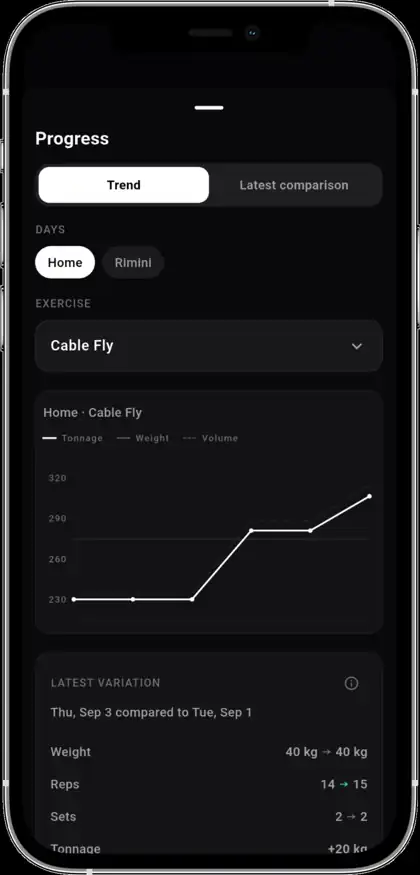
Progress is therefore a staircase, not a straight line. The load can rise while reps or tonnage temporarily fall.
Progress is a zig-zag, not a perfect line
Weight, reps, sets and tonnage do not have to increase together in every session. A heavier load with fewer reps can be exactly where the next progression cycle should begin.
Use the trend, not one isolated number. Raout shows weight, volume and tonnage together because each metric explains only part of what happened.
Tonnage is useful, but it is not muscle mass
If tonnage rises on the same exercise while range and technique remain comparable, your work capacity is improving. That is valuable information.
It is not proof that every increase came from new muscle. Neural adaptation, coordination and becoming better at the lift also improve performance, especially early on.
How much weekly volume?
There is no magic set count. The evidence supports a dose-response relationship between weekly set volume and hypertrophy, with diminishing returns as volume rises. Productive growth is seen even in moderate weekly volumes.
A pragmatic starting range is roughly 6–12 hard sets per muscle per week. For a beginner, around 9–12 can work well because technique and RIR judgement are still developing; the goal is not to maximize volume, but to learn to express good sets consistently.
Frequency distributes quality
Training a muscle multiple times per week is useful mainly because it spreads the weekly work. At matched weekly volume, higher frequency is not consistently superior for hypertrophy.
Instead of cramming twelve chest sets into one session, splitting them across two or three exposures often keeps technique and effort quality higher. Around 48–72 hours between hard exposures is a practical reference, not a biological timer.
Stimulate, recover, repeat
Muscle damage and soreness are not the target. Especially when a movement is new, part of the protein-synthesis response is tied to repair. With repeated exposure, damage falls and the training becomes more efficient.
Do enough to create a useful stimulus, then recover well enough to produce another high-quality session. Full-body training works very well for this because it naturally spreads the stimulus; if sessions become too long, use more days or a simple upper/lower or push/pull structure.
Save time with jump sets
Alternate exercises that interfere little with each other: bench press, then a curl, then back to bench. Antagonist pairings such as biceps and triceps work especially well.
The working muscle keeps recovering while another area is trained. This is different from turning every pair into a no-rest metabolic superset.
The complete model
Choose useful exercises and keep them long enough to learn them. Keep technique and range comparable. Train hard, progress reps inside a range, then add load. Use enough weekly volume, distribute it so set quality stays high, and do not chase soreness for its own sake.
Then track the trend. Progressive overload is not forcing numbers upward; it is creating a system that lets you see whether your capacity is actually improving.
Sources
- Schoenfeld et al. — weekly set volume and hypertrophy
- Pelland et al. — resistance-training dose response
- Grgic et al. — training frequency and hypertrophy
- Siddique et al. — neural adaptations to resistance training
- Damas et al. — muscle damage, protein synthesis and hypertrophy
- Refalo et al. — proximity to failure and motor-unit recruitment
Training guide
Exercise guide
Barbell Bench Press →
Exercise guide
Barbell Squat →
Exercise guide
Romanian Deadlift →
Exercise guide
Incline Dumbbell Curl →
Exercise guide
Single-Arm Cable Lateral Raise →
Exercise guide
Single-Leg Dumbbell Standing Calf Raise →
See the trend, not just today’s number.
Raout keeps previous performance, weight, reps, volume and tonnage in view so progression stays tied to the same exercise standard.